
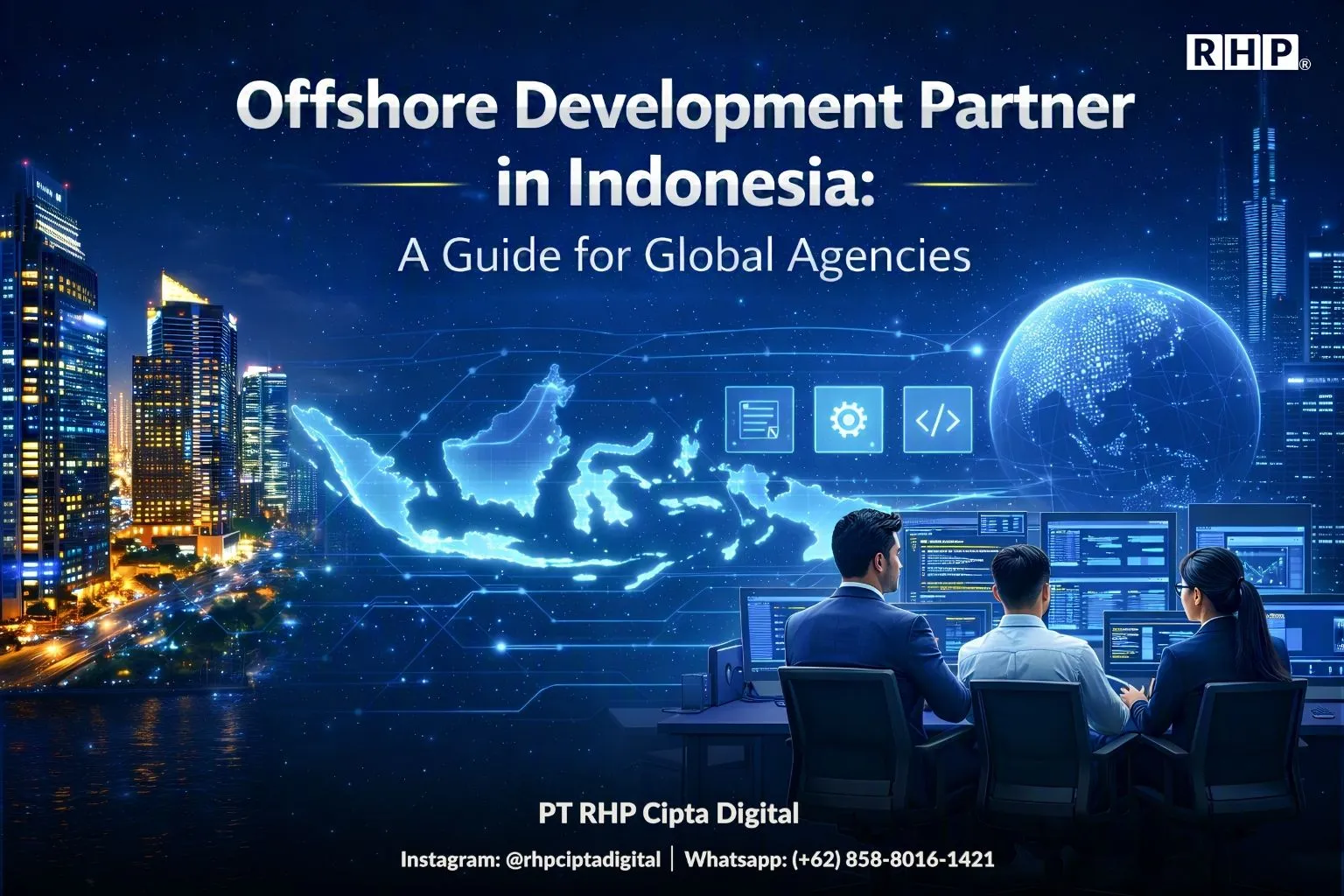
Agencies in the US, UK, and Australia increasingly look beyond their own borders for delivery capacity. India and the Philippines dominate that conversation, but a growing number of agencies now work with an offshore development partner in Indonesia instead.
This guide covers what makes the Indonesian market different, how the time zones actually work, and how to evaluate a partner before you commit client work to them.
Why Indonesia
- Time zone position. Jakarta sits at UTC+7, giving a full working overlap with Australia and most of Asia and a partial morning overlap with Europe.
- Depth of talent. A large developer population that is not yet saturated by outsourcing demand, which keeps retention higher than in more mature offshore markets.
- Rate position. Well below North American and Western European agency rates, above the cheapest offshore markets, with the quality difference that gap implies.
- English in professional settings. Standard in the technology sector, particularly among teams that already serve international clients.
The trade-off is honest: there are fewer established partners than in India or the Philippines. Vendor selection carries more weight, and you should expect to do more diligence rather than less.
Related reading: White Label WordPress Development for Agencies: Working Models and Pricing
How the working day actually overlaps
| Your location | Live overlap with Jakarta | Practical model |
|---|---|---|
| Australia (Sydney) | Most of the working day | Real-time collaboration, same-day turnaround |
| Singapore, Malaysia, Hong Kong | Full working day | Treat as a local team |
| UK and Western Europe | Jakarta afternoon, your morning | Daily overlap window for calls and unblocking |
| US East Coast | Minimal during standard hours | Asynchronous handover, queue at end of day |
| US West Coast | None during standard hours | Asynchronous handover with strong written briefs |
The asynchronous model works well, but only when your briefs are written to be actioned without a follow-up question. Agencies that brief verbally and clarify in Slack throughout the day tend to struggle with a twelve hour gap until they adjust their process.
Dedicated team or project delivery
Both models are common, and the right choice depends on how predictable your pipeline is.
- Dedicated team. Suits continuous work. The partner accumulates knowledge of your stack, your standards, and your clients, which compounds over time. You carry the cost of idle capacity between projects.
- Project delivery. Suits lumpy demand. You pay per scope and carry no bench cost, but you also start each engagement with less accumulated context.
Many agencies start with project delivery on a low-risk piece of work, then move to a dedicated arrangement once the working relationship has proven itself.
Related reading: How Agencies Add Delivery Capacity Without Adding Headcount
What to check before you commit client work
- Named case studies you can verify. Not logos on a wall. Ask which specific problem was solved and what the outcome was.
- Who you will actually work with. Confirm the people in the pitch are the people on the project.
- A written escalation path. What happens when a deadline is at risk, and who has authority to decide.
- Willingness to work in your tools. A partner who insists on their own project management system adds friction to every handover.
- Estimates that respond to scope. A partner who pushes back on your brief is usually a better sign than one who agrees to everything.
- Ownership of accounts and repositories. Everything under your name, with the partner added as a user.
Protecting the white label arrangement
If you are reselling the partner’s work under your own brand, the commercial protections matter as much as the technical ones.
- Put the end client identity inside the confidentiality agreement, not just the project details.
- Require that the partner never contacts your client directly, under any circumstance.
- Confirm deliverables carry no partner branding, including code comments and footer credits.
- Agree in writing who carries responsibility if a delivery defect reaches the client.
That last point is the one most agencies skip, and the one that matters most when something actually goes wrong.
Frequently Asked Questions
Why do agencies choose Indonesia over India or the Philippines?
Indonesia sits in a time zone that overlaps the Australian and Asian business day, has a large developer pool that is not yet saturated with outsourcing demand, and rates that sit below Western Europe and North America without the churn common in more mature offshore markets. The trade-off is a smaller number of established partners, so vendor selection matters more.
How does the time zone difference actually work?
Jakarta is UTC+7. That gives a full working overlap with Australia and most of Asia, a partial morning overlap with Europe, and no live overlap with North America during standard hours. Agencies in the US usually run an asynchronous handover model, where work is queued at the end of their day and reviewed the next morning.
What does offshore development in Indonesia typically cost?
Market rates generally run well below North American and Western European agency rates while sitting above the cheapest offshore markets. The exact figure depends on seniority, engagement model, and whether you are buying a dedicated team or project delivery. Ask for a rate card broken down by role rather than a single blended number.
Should we hire a dedicated team or buy project delivery?
It depends on how predictable your pipeline is. A dedicated team makes sense when you have continuous work and want the partner to accumulate knowledge of your stack and clients. Project delivery suits agencies with lumpy demand, where paying for idle capacity between projects is the larger risk.
How do we protect client confidentiality in a white label arrangement?
Put the end client identity inside the scope of the confidentiality agreement, not just the project details. Require that all repositories, hosting, and analytics accounts sit under your ownership with the partner added as a user. Confirm the partner will never contact your client directly and that deliverables carry no partner branding.
What are the warning signs of a weak offshore partner?
No named case studies you can verify, a single point of contact who disappears once the contract is signed, no written escalation path, unwillingness to work in your project management tool, and estimates that never change no matter what you scope. A partner who pushes back on your brief is usually a better sign than one who agrees to everything.
About RHP
PT RHP Cipta Digital is an international digital and marketing agency based in Jakarta. We work as a white label delivery partner for agencies abroad, covering custom web and application development, WordPress development, and SEO, always under your brand and never in contact with your end client.
We have delivered more than 100 projects and generated over 1,000 B2B leads for clients in the United States, Indonesia, and several other countries.
Talk to us about capacity
If you are evaluating an offshore partner, we are happy to walk through how a working arrangement would look for your pipeline, including the parts that would not suit us. The first conversation is free and carries no obligation.